Saturday, January 10, 2009

Back to the uni-knot


The diagram of the uniknot is borrowed from Paul's fishing kites website. As you can see a loop is made in the tag end then the tag end passed trough the loop and around the object to be tied. In this case the main line to attach a swivel. The reason I said it that way is to show you the versatility of the knot with words.

Snelling a hook with the uniknot you would pass the tag end through the hook eye make the loop and pass the tag end through the loop and around the object, the hook shank.

Line to leader with the uniknot your object is first the leader line then you make another uniknot with the leader around the second object the main line. Snug both lightly, pull the knots together then snug tight. That is a back to back uniknot.

You can make a double line with the uniknot by doubling a length of the your main line then using a back to back uniknot just like the line to leader.

You can even tie wire directly to your main line with a minor modification. Make two wraps around The wire, then fold the wire end running up your main line back on itself, then pass the main line tag end through the loop and around the both the wire and the folded back wire tag end. This is called a dog knot and is quite useful for fly fishermen targeting toothy critters.

Depending on the line size and type you should adjust the number of passes through the loop. For 15 to 30 pound six passes. Under 15 pound and thin braided lines, seven or eight passes as the line gets smaller. For over 50 pound, five passes decreasing to four passes as the line size goes up. Lubricate the knot with spit before snugging to prevent chaffing and help it draw tight especially with the heavier leaders.

The uniknot was invented by Vic Dunaway and is included in his book Baits, Tackle and Rigging. If you are serious about learning to fish that is a must for your reading room.

All of the uses mentioned are in Vic's book except for the dog knot which is a bit rare in fishing circles. Now go practice your uniknots.

Marathon in the Florida Keys should be your next fishing vacation destination. Join us for charter fishing, fishing guide trips or our fishing 101 so you can fish on your own with better success.

Tight lines,

Capt. Dallas

Friday, January 09, 2009

More Fish Cleaning Table Stuff


Just to show you guys that I do more than fish here is the basic Conch Concepts fish cleaning table base. It is made of pressure treated 2x4 and 1x6. Some people were concerned that 2x4 was not sturdy enough for building the table base. This sucker is solid. The secret is the 1x6 frame under the table top. This is glued and screwed into the 2x4 legs to prevent racking. Also the bottom 2x4 frame is cut to get the maximum bite into the legs. The materials for the pressure treated base cost less than 25 bucks for you do it yourselfers if you spend the time digging for straight lumber at the Home Depot.

Our plans are to include the drawings for the basic base with the top which will retail for $399. We also are working on a powder coated square aluminum base, round pipe stainless or aluminum base, the two leg bent aluminum light travel base and of course the ultimate Tiki cleaning station.

My next project is to enclose the basic pressure treated base to add two drawers for knives, baggies etc, and two doors for storage under the table. The basic pressure treated base won't blow wind up many skirts, but enclosed with some nice cedar or other material it will look hot. Once that design is complete we should have a product sexy enough to impress any fisherman.

Fishing wise it was a good day for the few boats that were booked. The only down side was that sailfish were slow today.

Marathon in the Florida Keys should be your next fishing vacation destination. Join us for charter fishing, fishing guide trips or our fishing 101 so you can fish on your own with better success.

Tight lines,

Capt. Dallas

Sunday, January 04, 2009

Fishing the Florida Keys Fishing Tips: My Knots


I teach a lot of people to fish here in the Keys. Since most are new to saltwater fishing I keep it simple and teach basic stuff that works. There are a good number of repeat customers that I teach the more advanced stuff. Even the more advanced techniques I try to keep simple. The way I do things often varies from the way other captains do things, but there is a method to my madness.

Knots to know: The Uni-knot, Spider Hitch, Haywire Twist and Bristol or No Name knot.

With that short list of knots you can tie any rig or leader system for any type of fishing in the world. Actually, the uni-knot alone can do almost everything, it is the most versatile fishing knot ever invented. Most captains have no problem with the uni-knot but a few do. So the reason I prefer the Uni is its versatility and its 98% break strength. There are 100% knots that many captains prefer so here is why I would rather use a weaker knot. I know where the line will break.

Imagine hooking a huge fish and getting spooled. That is a regular occurrence here in the Keys. The uni-knot will break when you run out of line so you don’t lose your whole spool. That’s a good thing for you but a better thing for the fish you lost. A fish dragging a few hundred yards of line probably is going to die. That’s bad. Those fish that whip your butt are valuable. They bring people back for a potential rematch.

The Spider Hitch is used for the same reason as the Uni-knot. It is a 96% strength knot used to make a double line. Most captains prefer a Bimini Twist that is 100% strength for making double lines. I like knowing where the line is going to break for the fish and my wallet’s sake. Another reason I don’t use the Bimini Twist for everyday fishing is the size if the knot. There are a lot of small fish with sharp teeth in the Keys. They will often mistake the Bimini Twist for a small minnow and cut you off. The small size of the Spider Hitch saves you money by reducing lost trolling lures. The Spider Hitch also is less likely to catch on the spool when casting and goes through the rod guides more freely.

The Bristol or No Name knot is a leader to double line knot. It is a good knot used by many captains so I don’t get much argument here. Same with the Haywire Twist, which is the most common solid wire knot used in the world.

Some captains question the way I use these knots. For example, my leaders on spinning rods are a lot shorter than most captains use. I use about five feet of double line and about six feet of leader. The shorter double line/leader makes it easier for my customers to cast. Since I don’t have a mate to blame I want to make it easy for my customers . Also the shorter leader is fish friendly for the ones that get away. My wire leaders are also shorter than most for the same reason.

My next post will be about how to tie these knots and different rigs I use in the Keys.

Marathon in the Florida Keys should be your next fishing vacation destination. Join us for charter fishing, fishing guide trips or our fishing 101 so you can fish on your own with better success.

Tight lines,

Capt. Dallas

Saturday, January 03, 2009

When Nature Calls

Marine heads or toilets are not built like your home facilities. To maintain the respect of your captain and crew learning the subtle differences in procedure is a must. Following a crisis of epic proportion I wrote the following article.

The Art of Butt Wiping: Hiney Hygiene
One of the biggest parts of proper hiney hygiene is the etiquette of maintaining the integrity of the throne. Following these basic tips will endear your with the community.
Read more

Enjoy

Marathon in the Florida Keys should be your next fishing vacation destination. Join us for charter fishing, fishing guide trips or our fishing 101 so you can fish on your own with better success.

Tight lines,

Capt. Dallas

Friday, January 02, 2009

Chicago Joe and Crew Fishing Vacation


Just got finished with Chicago Joe and Crew. On the whole it was pretty good fishing. We had two real good days, four good but not spectacular days and one that just plain sucked due to wind. The crew wanted action and some eating fish. Jacks like those in the picture and mackerel provided plenty of action.


Lane snapper like the one above, mangrove snapper, nice porgies and on the last day a nice red grouper provided dinner. I was disappointed that I could not get them on a few sailfish. We raised one and had it spooking our baits on day six, but couldn't get it to eat. That kinda sums up the trip. Plenty of action, lots of nice fish but a lot of missed opportunities.

Marathon in the Florida Keys should be your next fishing vacation destination. Join us for charter fishing, fishing guide trips or our fishing 101 so you can fish on your own with better success.

Tight lines,

Capt. Dallas

ETA Joe sent me some more of your pictures.

Monday, December 29, 2008

Dang Level Winds and Braided Line

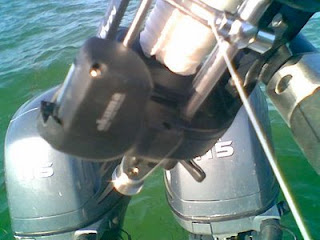
It was a beautiful day in the Bay yesterday. The guys caught plenty of fish including several sharks that they wanted. They also missed quite a few nice fish. The power pro got bound in their level wind reel so tight we couldn't get it out. The picture above isn't that clear, but if you look close you can see the bind on the left and the wind guide is to the right. Level winds and braid are great for losing big fish.

Some people love their braid and level wind reels. Here is some advice from a braid devotee:

captdallas2,

I have used braided lines for years and used to have some of the same issues you seem to be facing. Here are a few things I have learned about braided lines over the years:
1. Braided lines must be spooled on the reels very tightly. A good test is to press down on the spool with your thumb. If it feels at all soft, then the line is not tight enough. When respooling braided lines, I have someone hold the spool with enough tension so the rod bends. That way the line goes on tightly and the spool feels hard. No digging in that way.
2. Use braided lines based on line thickness and not strength rating. For instance, 65 lb braided line typically has the same thickness as 14 lb mono. So, if you normally use 14 lb mono, then use 65 lb braided line. 12 ln mono typically equals 50 lb braid and so on.
3. Braided lines need maintenance. Watch it for frays especially when fishing around weeds or rocks. I imagine this will apply more to in-shore fishing.
4. Its important to put at least 10 yards or so of mono backing on the spool before spooling with braided lines to keep the whole spool from slipping. A similar diameter usually works well and a blood knot does the trick.

When Muskie fishing, I use 80 or 100 lb braided lines, which typically are in the 18 to 20 lb diameter range. I put the lines on tight and check for frays before every outing. The heavier line allows smoother and longer casts, less dig-ins, and much better durability.

Based on your picture, it may be the line on your reel just needs to be re-spooled tighter.

Good fishing. =)

I still say level winds and braid sucks.
Marathon in the Florida Keys should be your next fishing vacation destination. Join us for charter fishing, fishing guide trips or our fishing 101 so you can fish on your own with better success.

Tight lines,

Capt. Dallas